Sunday, 15 April 2007

Ranthambhore National Park

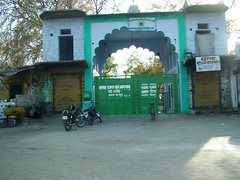
So this part of the trip was a complete suprise. Before we came we hadn't even considered going on safari looking for tigers. So we had no binoculars. Set off in an open top jeep. Zooming along the road at 5.30am. Picking up two other parties along the way - an older German couple and a journalist researching an article on Tiger safaris around the world. The German lady had a proper camera with an appropriately long lens. I had camera inferiority complex.

Set off expecting to just enjoy the scenery and not see any tigers. We felt it best so as not to be disappointed. We got zone 3 much to the disappointment of the germans who had read in their guidebook that nobody had ever seen a tiger in zone 3 (only 5 vehicles were allowed in any one zone for each session).

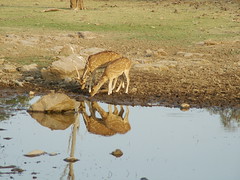
Our guides listened out for deer alarm calls. Drove to appropriate points to watch and listen. Pointed out other wildlife. We watched the sun rise.
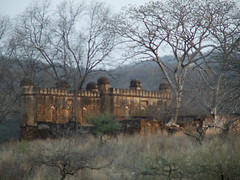
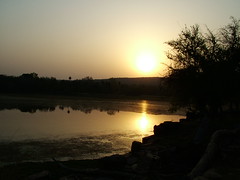
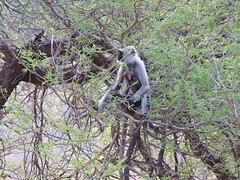
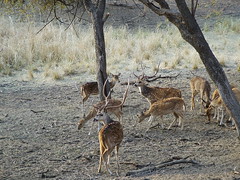
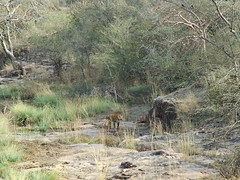
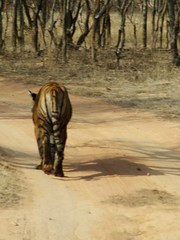
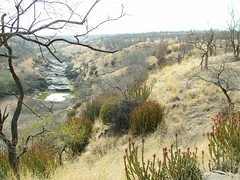
Then they saw the tiger - moving from a hiding place by a pond. She came out, walked round and went off into the woods. We were amazed. Huge beast wandering freely. And we were off - racing along the tracks to hopefully catch her when she emerged over the hill, bouncing and thrown about in the jeep, holding on for all our worths. Stopped when we saw her emerging from the woods again. She wandered along, marking her territory, coming closer and closer to the jeep. Totally unpeturbed by our presence. So close we could have reached out and touched her.
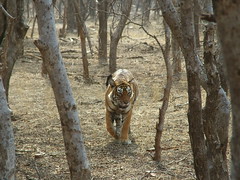
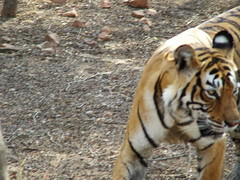
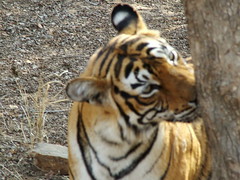
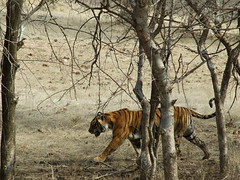
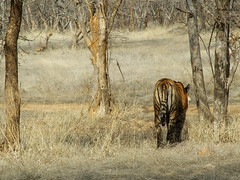
I had to keep reminding myself that she was wild. We weren't in a zoo. They weren't caged. There are no boundaries to the park - tigers do occassionally leave, particularly young males looking for a territory, which is when they get into trouble (farmers are concerned about tigers living close by to their livestock).

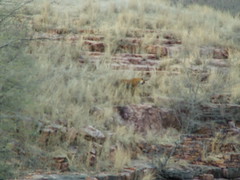
Later that day we were on our second safari of the day - an afternoon session. We really did expect to be just looking at the scenery this time, after such fantastic views earlier in the day. We were in a different zone, its terrain was quite different, higher, rockier, not as many watering holes. But someone with eagle eyes spotted an enormous male sitting in a cave. Visible only through binoculars, which our jeep companions kindly shared. We waited over an hour. He eventually came out and bounded up the side of the hill as if it were nothing. About three leaps. Wandered along and disappeared around the corner.
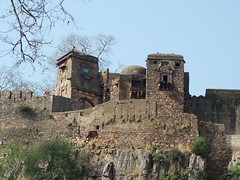
We went home after the sun had gone down, feeling very lucky.

Full safari flickr photostream.

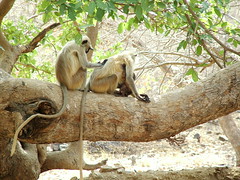
Sightings: spotted deer, cormorant, crocodile (heads poking out of the water x2), sambar deer, tiger (13 year old Royal Bengal Tiger female, one of the biggest males in the park), peacocks and hens, egrit, macack monkeys, kingfishers, gazelle (x2), mongoose, langa monkey, brown fisher owl, Quail - running along the ground, honey buzzard, black stork (in flight).
On the Road

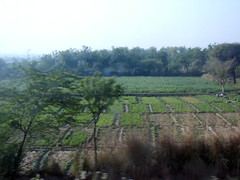
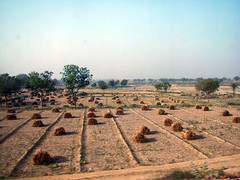
Driving from Agra to Ranthambhore. Agricultural landscape - small scale. End of the first harvest - fields are full of people working. Small holdings. People and animals coexist. Washing rituals at the pump. Grain stores - woven like enormous baskets, straw up piled up against the house. Dotted along the road are villages, or watering holes, sometimes the equivalent of just the corner shop - selling sweets, fanta, water, a few plastic chairs outside.

A barber. His shop a chair inside a lockup shed. Cut-throat shaves and hair cutting.

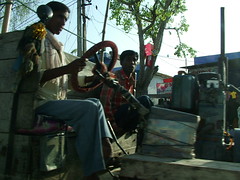
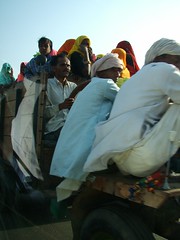
Vehicles on the road without number plates - homemade by farmers for farming. Long open engines like tractors mounted on a platform, long steering wheel posts, similar to the first cars without windshields. Putput along the road, sometimes pulling a load of grain, sometimes loaded with farm workers - western dressed men and women in colourful saris, yellow, pink, blue, red.

Families on motorcycles. Dad driving, 2-3 kids squeezed in the middle, mum on the back riding sidesaddle. Nobody wears a helmet.

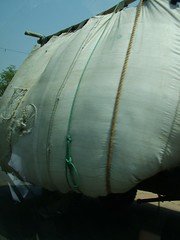
Trucks carrying grain in huge canvas bags so full the load hangs over the sides and off the back. So full and overloaded can't quite understand how the truck manages it.

Jeeps full of workers speeding down the road, overtaking, people clinging to all possible available space - on the roof, hanging onto the side, standing on the open back door flapping one hand on the roof rack. People walking out of the fields with bundles of twigs, huge bags of grain, stacks of waterpots, belongings, balanced on their heads.

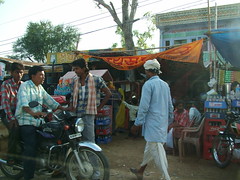
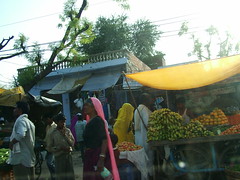
Then sporadically a town. Shops painted deep yellow with red and black writing or coca cola adverts painted in red and white. Houses painted blue (shades of aquamarine and turquoise or pale blue) or pink. Throng of people, cows, goats. Stalls - cloth, fruit, vegetables, eggs, motorbikes, rickshaw wheels. Crowd of men around a 'cafe' (water, fanta, food, chai).


Brick works. Stacked bricks, rectangular ditches and chimneys puffing out smoke. Rows of masons, all manner of carved stone vessels, domes, gods, walls. Ready to be assimilated into new buildings.

Goat herders, cow herders, sheep. Every once and a while a seemingly discarded shrine with a dome and idols. Kids playing cricket. One game had a plank for a bat. Another had a pile of bricks for wickets.

And when we ran out of road we were on a track covered in lumps of rock where the road was being resurfaced and expanded, travelling with local traffic, barely slowing down.

Peacocks and hens in the fields like grouse.

Deeper and deeper we get fewer vehicles, worse road, more men in traditional dress so they fit better with the women in saris.

I'm feeling very western - consumerist, excessive, privileged. Luxury of being able to be unhappy and dissatisfied. Bound by things, ownership and ambition. All of which seem pointless here.

Closer look at the pictures here.

Saturday, 14 April 2007

Keoladeo Ghana National Park

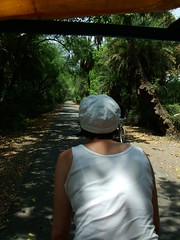
So, driving away from city life we stopped at the bird sanctury. Out of season the wetlands were dry in the most part. But in the rainy season it apparently is a haven for migrating birds and covered in water. We took a rickshaw ride to the middle of the park, the driver of which pointed out birds and animals on the way. Hot and dry. Peaceful. In the centre of the park was a plaque recording figures of past shooting parties - ranging into the thousands apiece - pretty senseless seeming.


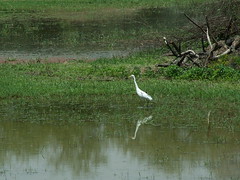
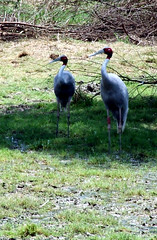
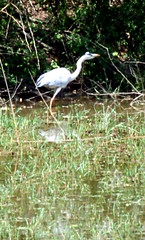
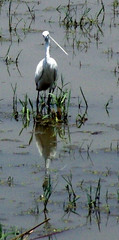
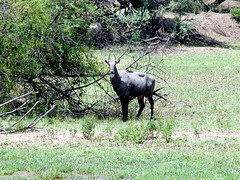
Little egret, heron, crane, and a nilgai (blue bull).

And here's a picture of my sister pretending to be a rickshaw driver (we had a great deal of guilt being cycled around with our great western arses by wirey Indians) shortly before she lost control and we careened off the road, capsized and spilled into the road. She felt less guilty about riding rickshaws after because it wasn't hard pulling us along but crushed with guilt about overturning the rickshaw!


Sighting list: peacock (x2), white breasted Kingfisher (x2), lapwing doves (lots), Tiger bird (cleans the teeth of tigers - tree pie (lots), minor birds (lots), black drango (forked tails) (lots), female black radistag?? (x1), crow pheasant (x3), cattle egret (eats flies off cattle and deer) (x1), crane (mate for life - always seen in pairs) (x8), redwater lapwing - from sri lanka (x2), black necked stalk (from sri lanka, blue eye= male, yellow eye=female) (x1), ring dove (x2), large egret (x1), grey heron (x1), jungle crow (big and fat) (x1), little egret (black beak), spotted owlet (x2), sandpiper (x1), green bee eater (x1), magpie robin (x4). Also saw sambar deer, monitor lizard, turtles and nilgai. Not sure whether these are exactly the right names of the birds - it was sometimes hard to understand the driver!

Flickr photostream.
Fatehpur Sikri

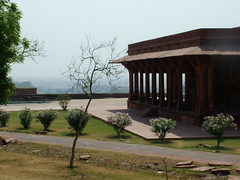
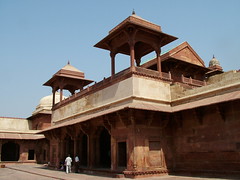
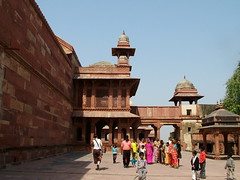
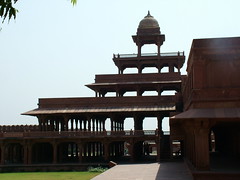
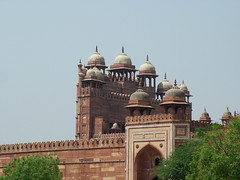
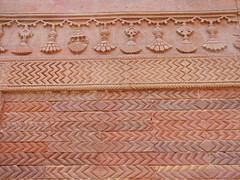
A deserted city. Built by Mughal Emperor Akbar in 1571. It was the Mughal capital city for 14 years after which it was abandoned, due to lack of water apparently. It stands on a hill looking out over the planes. Its beautifully preserved, like it was abandoned only recently.


Flickr photostream of Fatehpur Sikri.
Unformed Thoughts

We're seeing people with next to nothing, living in tiny rooms, businesses that are little more than a stall, perhaps they are selling mouth freshener or have a grinder and fix things, families all together, washing in the river or a pump on the corner of the road. We have so much - the space and luxuries that we take totally forgranted. Bathrooms, fresh water, hot water, a whole house to ourselves, more food than we can eat, in fact waste food.

There are some things that are hard to get used to. Like... Every question answered is worth a few rupees. Every helpful gesture is tippable. Looking after shoes at the temple is worth 5 rupees, 1 day tip for driver 120. Like... Every price is negotiable. Shopping is fraught with pressure. We tire of bargaining quite quickly and instead prefer not to go into shops. Its difficult largely because we aren't sure whats acceptable or what costs are (as yet).

Children tug at my sister's heartstrings. There are children younger than her eldest (who is 4 and a half) looking after babies. They are ages at which British kids are toddling round and learning to speak. Can't imagine my neice having to look after her brother - keep him safe, feed him. I think they would be in grave danger. Here its different.

Trendy young Indian men wear high cut jeans tigher at the top and flared at the bottom with skinny fitting shirts - similar to 70s man. I've grown so used to men with low slung trousers, hipsters or positively hanging off that wearing trousers high seems strange.

Friday, 13 April 2007

Taj Mahal

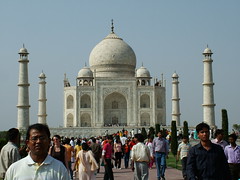
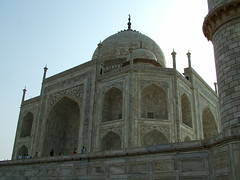
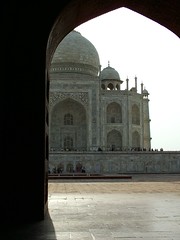
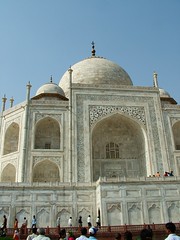
While I could take it or leave it, Amy's one must-see for the trip was the Taj. I was unprepared for the actual beauty of the building in real life - its such a famous image, exploited for all its symbolism by Diana, Princess of Wales. It was almost as though it didn't need looking at because it is already so well known.

However, it is a truly beautiful tomb. The whitest marble, opaqly translucent inlaid with semi-precious stones in floral designs remarkable in their realism and recognisable as particular species - lillies, poppies, lotus flowers and honeysuckle.


The site was being visited by many Indian tourists - visiting the north from the south (its cooler there - but its all relative when its 43 degrees). A family wanted to have their picture taken with us. Strange to be so strange.

Flickr photo stream - more pictures or to have a closer look.
Varanasi to Agra

Train journey. 3rd class night train. 3 bunks, narrower than 2nd class. More tourists. Well prepared Germans with sleeping sheets, chains and padlocks to lock up their rucksacks, torches on headbands for reading in bed.

Chimneys from brick making. Pits where the clay has been dug from the earth. Piles of bricks stacked up neatly after firing.

Small groups of buildings close togehter with old men sleeping outside on strung beds under the shade of trees. Cow sheds, children, goats, chickens. People washing at water pumps.

As light fades we pass a shrine on the side of the road, a candle burning. 3 cows graze nearby and a man in pale blue robes walks away.

In the morning agricultural land slips past the window. People integral to the landscape.


Flickr photo stream here
The Ganges

There's a sign on the wall that reads, "The Ganga is the life blood of India". Also referred to as the Great Mother. In the travel agent in Delhi a seasoned India-traveller asked where we were going. Varanasi was her second favourite place in India (used to be her first but she subsequently went to Kashmir and that has taken 1st place now). Very spiritual, she said. She spoke like she'd smoked too much dope - sort of slowly, with consideration.

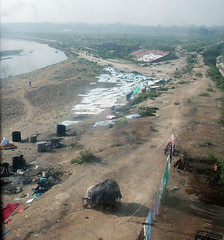
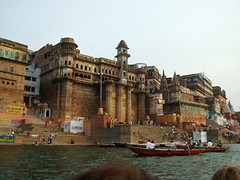
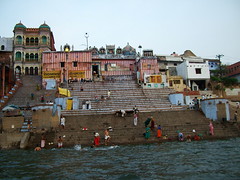
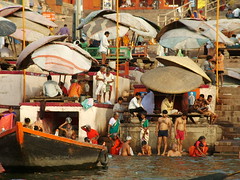
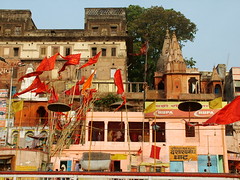
At 5.30am we walked through the tight knots of streets down to the Ghats sitting on the Ganga's edge. Down the steps to the river, where we picked up a river boat that took us along the riverside - looking at the riverside temples, people bathing and washing their clothes, cremation pires at the far reaches tended by men with long poles, umbrellas, flags. Sun rose. Yogi's instruct their followers sitting cross legged on concrete platforms. Tourists survey the scene from rowing boats.


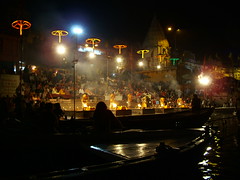
Much later we found ourselves back on the boat, watching prayers at one of the river side ghats, lights against water, monks wafting insense smoke and pots of fire, people pushing banana leaf bowls with tea lights inside into the water. The prayer leader's singing chants waft out across the water combined with bells clanging and drums.


For a closer look or to see more pictures of Varanasi click here.

Wednesday, 11 April 2007

Varanasi

Arriving at the train station was like being in the set of The Jewel in the Crown - dust covered platform full of people - beggars, travelling farmers and business men, huge families with cases and food supplies waiting to board, chai sellers with steel teapots and a bucket full of unglazed terracotta handleless cups, porters in red robes, handpulled carts, bicycles, tourists, taxi drivers with handscrawled names on paper. Very old fashioned, poor and people with missing limbs, deformities and injuries. Arrivals feeling rather overwhelming.
Night Train to Varanasi

On a cockroach infested train, in a couchette thats very hot (especially with the curtains shut) Amy and I are pretending we're in Some Like it Hot (heads popping through the gap in the curtains). She wants to be the double bass player, then the trombone. Do wab do wab. Then I was upset to discover that I haven't got a sneer so my Elvis impersonating days are over - I've mastered the hair but haven't got a good upper lip sneer on either side.

Standing looking out of the open train door in the morning it passes through agricultural fields full of women cutting grain crops, people carrying water and goods on their heads. Talking to a Seikh who said he was once in California in a village and there was nobody in the landscape which he found really strange. Here the landscape is full of people, and dotted with ramshackle buildings full of cows, goats, and people washing, cooking, eating.

The train stopped and a fight broke out on a path outside - a man was on the ground being beaten, kicked, punched, stamped on the head and stoned. Set upon by 10 others. The gaggle of men watching from the train door decided he was a pick pocket who had been chased off he train and was getting his just desserts.

Tuesday, 10 April 2007

Snapshot of Delhi

Culture shock, fear, arranged the trip. Sightseeing in 43 degrees - driven round in a taxi by a lovely driver with a variety of tour guides (in the loosest possible sense - sometimes felt they were more like chaparones becuase they could barely tell us more about the places than a name).


Flickr photo stream - if you want to take a closer look.
Delhi

We arrived middle of the night. While it didn't go quite according to plan its OK, sort of. We're staying in a different hotel, going to places we didn't know about. Its really really hot and dirty. But the driver we have has been very nice.

Can't quite decide whether we are being taken for a ride totally, even though the people who are doing so are very nice about it. I've been bitten by mosquitoes terribly - everyone keeps asking me whats wrong with me (I look like I have a terrible disease or something).

Seen some stuff, been made to wear a fabric bag over my skirt into the Jama Masjid Mosque - much to the amusement of the locals. Indians like to be in love, I believe. All the public gardens are full of couples. Canoodling in the shade from the heat of the day.

Amy has been keeping an animal count which I think amuses the driver - its all so ordinary for them - cows in the street (big white ones), ox (which big humps on their backs), monkeys, parrots, eagles, hooded crows, and circus elephants (not performing just standing around the big top, thought it best not to think too hard about it).. All of which hopefully will seem ordinary to us once we've been on safari (cross your fingers for tigers).

Saturday, 7 April 2007

Jetting Off

I'm off to India for two weeks. Going to a wedding in Jaipur. Flying into Delhi tonight. Other than that we have no plans! Its all to be decided on arrival. So, I'll blog sporadically if I find a connection!

See you when I get back.

Thursday, 5 April 2007

"How to" "Hoxton Fin"

Now while this searcher is unlikely to have actually found the answer this time, I do believe that collectively we could provide a very good answer to how to hoxton fin. For those of you not in the know, a hoxton fin is a haircut for men, not some kind of whacky ballroom dance.

I think there are two ways to get the look, although only one of them is truely effective. You can either get gel (one of the new less sticky but strong ones) and use the flats of both your hands to press the middle of your hair together in the middle, or, preferrably you need to go to a fancy hairdressers or trendy barbers for a proper asymmetrical haircut which is longer in the middle of the head. They will give you the benefit of their hair advice as to how is best to get that all desirable central uplift.

Beware though, this haircut is well and truely over. Nobody but children's tv presenters and second-rate boybanders wear their hair this way anymore. So I ask you, do you really want to hoxton fin?

Tuesday, 3 April 2007

White Dogs

As we said good evening on the steps of the old library we looked out over Bermondsey Spa Gardens and for the second time that day all the dogs in the park were white. Any size, any shape, any type, any colour as long as its white. Perhaps there's a local rule or something.